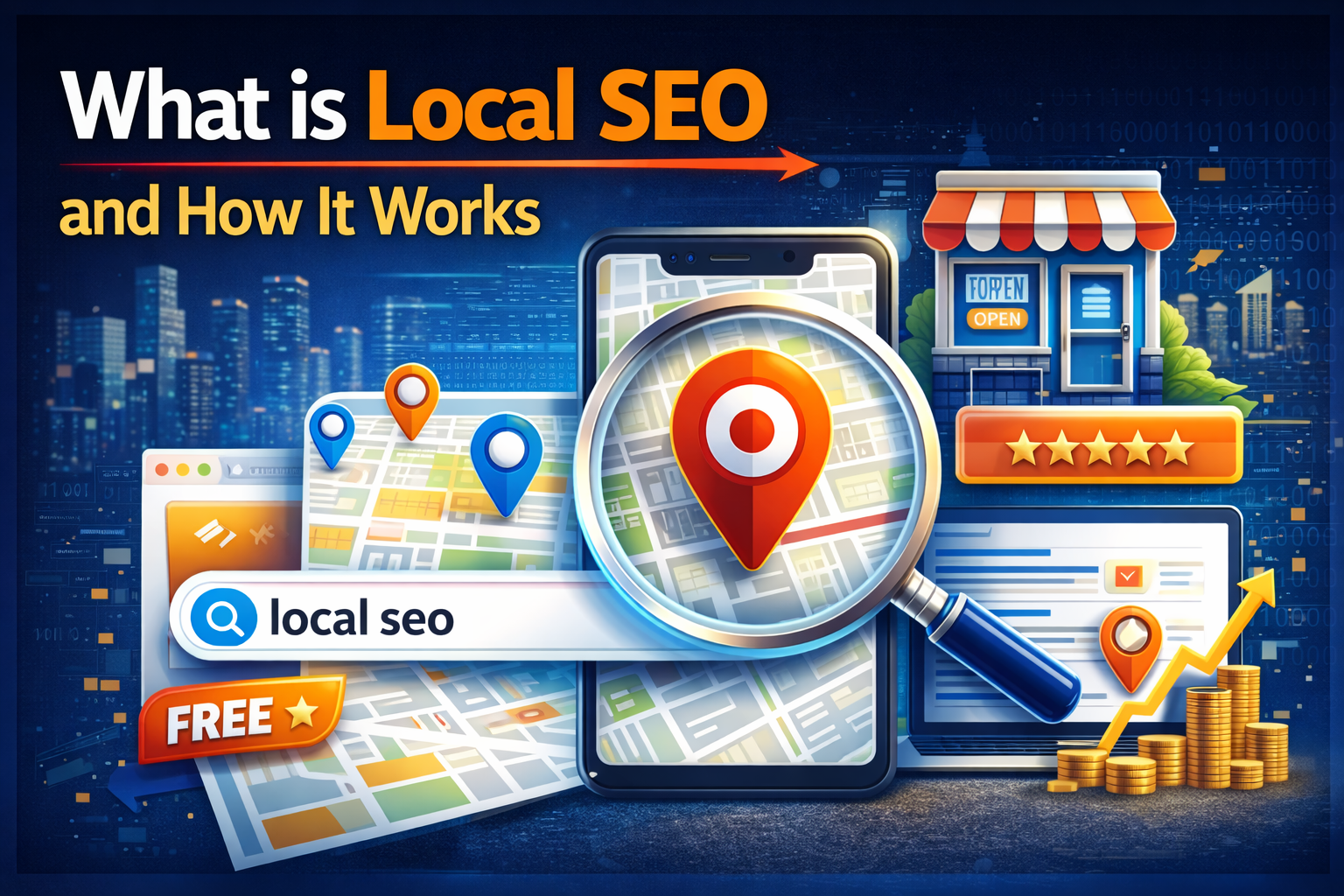
What is Local SEO and How It Works

A friend of mine runs a small plumbing business. Nothing fancy — just him and two employees covering maybe a 20-mile radius. For a long time, he was getting most of his work from word of mouth, and he was fine with it. Then one slow winter he started obsessing over why people were calling a competitor instead of him when they searched "emergency plumber near me."
That question led me down a rabbit hole I wish someone had explained to me plainly two years ago.
What local SEO actually is (and why it's not the same as regular SEO)
Regular SEO is about ranking for terms people search anywhere — "how to fix a leaky faucet," "best running shoes," that kind of thing. The person searching could be in Ohio or Singapore. Doesn't matter.
Local SEO is different. It's specifically about showing up when someone nearby is searching for what you offer right now. "Plumber in Ludhiana." "Best biryani near me." "Emergency electrician open Sunday." These are people ready to hire or buy, not just browse.
The result that shows up for those searches — that map block with three business listings, phone numbers, reviews, and hours — that's the thing local SEO is trying to get you into. Google calls it the "Local Pack." Getting into that box is often more valuable than ranking first in the regular blue links below it.
Why most business owners get this wrong early on
Here's where my friend was stuck — and honestly, where I see most people mess up.
They think local SEO is just about having a website. So they build a decent site, write some keyword-stuffed content, maybe pay someone to "do SEO," and wait. Nothing happens. Or it happens for the wrong keywords, pulling in visitors who aren't even in their city.
The real driver of local SEO isn't your website. It's your Google Business Profile (used to be called Google My Business). That's the listing that feeds the map results. If you haven't claimed it, filled it out completely, and kept it updated — you're basically invisible in local search no matter how nice your website is.
From what I've seen, at least half the small businesses I talk to either haven't claimed their profile or they set it up once and forgot about it. That's a significant miss.
How it actually works under the hood
Google uses three main things to decide who shows up locally:
Relevance — Does your business match what the person searched for? This is about having clear, accurate categories and descriptions in your profile and on your site.
Distance — How close is your business to the person searching? This one's partially out of your control, but your listed address and the area you serve matter here.
Prominence — How well-known and trusted is your business online? This is where reviews, backlinks (other websites mentioning you), and how often people click on your listing start to add up.
You can't game these with tricks the way older SEO tactics used to work. Google has gotten much better at detecting when someone is stuffing keywords into their business name or building fake links. It's not worth trying.
The review thing is real, and most people underestimate it
I know "get more reviews" sounds obvious. But the specific mechanics matter more than people realize.
It's not just the quantity of reviews — it's recency and response. A business with 200 reviews but the last one from 18 months ago often performs worse than one with 80 reviews that got three in the past month. Google seems to treat recent activity as a signal that the business is still operating and still relevant.
Responding to reviews also matters. Not because of some direct ranking signal anyone's proven conclusively, but because it tells Google (and potential customers) that the business is active and engaged.
My friend started just texting customers after jobs: "Hey, if we did good work, would you mind leaving a quick Google review? Here's the link." His review count went from 11 to 67 in about five months. His calls roughly doubled in that same period. I can't say reviews alone caused that — he also updated his profile — but the timing wasn't a coincidence.
What "citations" are and why they're quietly important
A citation is just any mention of your business name, address, and phone number on another website. Could be Yelp, Justdial, Sulekha, local directories, industry listing sites, whatever.
The thing that trips people up: consistency. If your address is listed slightly differently across 15 different directories — "Street" vs "St." vs a different phone number — Google gets confused. It's not sure which version to trust, and that inconsistency can quietly drag your rankings down.
Fixing this is tedious and unsexy but genuinely useful. Go find where your business is listed and make sure the name, address, and phone number are exactly the same everywhere. Exactly.
How long does this actually take?
Honest answer: slower than most people expect, faster than full-scale SEO.
If your Google Business Profile is incomplete or unclaimed, fixing that can show results in a few weeks. Getting into the top 3 of the local pack in a competitive market — that could take 4 to 8 months of consistent effort. Less competitive areas move faster.
The businesses I've seen struggle are the ones who do a burst of activity, don't see results in 30 days, and quit. Local SEO compounds. It's not a one-time fix.
Things worth paying attention to
- Your Google Business Profile categories. Pick the most specific primary category that fits, not the broadest one. A lot of businesses pick something generic and wonder why they're not showing for specific searches.
- Your business description in the profile. Don't stuff keywords. Write what you actually do, for whom, in what area. Readable and natural works better.
- Local content on your website. A page targeting "plumber in [your city]" that actually mentions neighborhoods, landmarks, and real service details will outperform a generic services page almost every time.
- Photos. Businesses with regularly updated photos on their profile get more engagement. It's one of the easier wins people skip.
- What happens after someone clicks. If your profile is great but your site takes 8 seconds to load on mobile, you're losing people at the finish line.
The one thing that matters more than people think
Most small business owners treat their Google Business Profile like a set-it-and-forget-it thing. They're wrong. It's more like a social media presence that directly affects whether people can find you at all. Posts, updated hours, new photos, responding to questions — all of it signals to Google that you're active.
Local SEO doesn't require a big budget. It requires consistency and attention to details that genuinely aren't that complicated once you understand what actually matters. The businesses winning in local search usually aren't doing anything exotic. They've just done the basics better and more consistently than their competitors.
That's the whole thing, really.