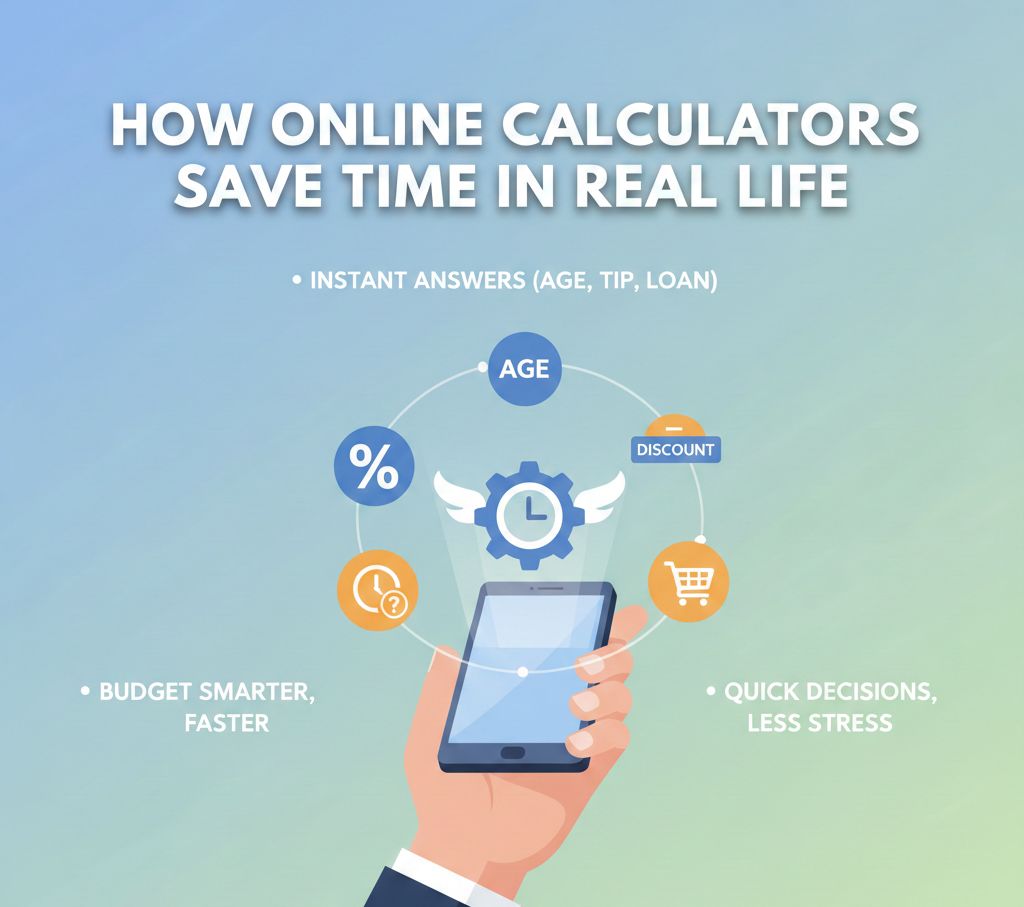
How Online Calculators Save Time in Real Life (Age, Percentage, Discount & More)

Alright, let’s talk about the most productive five seconds of your average Tuesday. It’s not the morning stand-up. It’s not the first sip of coffee. It’s you, squinting at a screen, hunting for that little blank box that’ll just tell you the answer. You’ve got a price, a discount, a tip, a date-difference nagging at you. And instead of reaching for a pen, or the calculator app you forgot was even on your phone, you open a new tab. You type. You get the number. You move on.
This isn’t just convenience. It’s a quiet, massive shift in how we handle the daily math of being alive. Online calculators—for age, percentages, discounts, mortgages, tips, body mass, you name it—aren’t just tools. They’re cognitive shortcuts. And in a world drowning in numbers, they’re not cheating. They’re surviving.
I’ll admit it: I used to be a snob about this. Journalism school drills into you the sanctity of verification, of doing the work yourself. Then I started actually doing the work. Filing expenses. Splitting a dinner bill six ways while everyone talks over each other. Trying to parse a credit card offer’s APR. The idea of manually calculating a 17.5% tip on a $87.63 tab, after tax, felt less like intellectual rigor and more like self-punishment. That’s the lived experience now. The mental load of a calculation isn’t in the arithmetic itself—it’s in the context switch. It’s the friction of pulling your brain from the flow of a conversation, a project, a thought, to become a human abacus for a second.
That’s where the save happens. It’s not measured in minutes, but in cognitive continuity.
Think about the last time you bought something online with a promo code. “SAVE30.” Does that mean 30% off the listed price? Off the pre-tax subtotal? Off the most expensive item? The site’s cart might show the final price, but the nagging doubt—did it apply correctly?—lingers. So what do we do? We open another tab. We find a percentage calculator. We plug in the original price and the final charge, working backwards. We’re not just calculating; we’re auditing. In that moment, the calculator isn’t a crutch. It’s a truth-verification tool, a tiny shield against opaque pricing algorithms. It empowers a form of instant, practical skepticism.
And it’s changing how we understand things that should be simple, but historically haven’t been. Take age.
Seems straightforward, right? But ask someone born on February 29th. Or try figuring out exactly how many days you’ve been alive (a weirdly compelling thought at 2 AM). The manual math is a minefield of month lengths and carried-overs. Online age calculators don’t just spit out years and months; they give you days, hours, sometimes minutes. It’s absurdly precise, and yet, that precision serves a human need—for nostalgia, for milestone-marking, for settling “who’s older” bets with a definitive, data-driven win. It transforms a fuzzy concept into a sharp fact.
This ease, though, it comes with a shadow. A reliance, maybe. There’s a legitimate concern about numeracy erosion. If we never do the math, do we lose the feel for it? Does a 15% tip become just a number a website gave us, instead of a value we comprehend?
Maybe. But honestly, in real use, I’ve seen the opposite happen more often. These tools act as a teacher by stealth. You see the relationship between the numbers play out instantly. You tweak the principal on a loan calculator and watch the total interest skyrocket in a way a textbook equation never made clear. You play with a discount tool and instantly see the difference between “20% off” and “$20 off.” The learning is visual, immediate, and tied to a decision you’re about to make right now. It’s applied math in its purest form. The expertise isn’t in memorizing the formula for compound interest; it’s in knowing what to ask, what variables matter, and how to interpret the output in your specific, messy life context.
The trustworthiness of these tools, of course, is a whole other can of worms. Anyone can slap a calculator on a website. The good ones—often tied to established financial institutions, reputable publications, or open-source platforms—earn their authority by being transparent. They show their work. They link to the underlying formulas or regulations. They include caveats: “This is an estimate. Rates vary. Consult a professional.” The shady ones might bury fees or use misleading defaults. The act of searching for the right calculator, then, becomes a mini- lesson in source evaluation. You learn to skip the ad-blotted, garish sites and find the clean, reference-backed ones.
That’s the real-world search experience: a frantic “tip calculator” that turns into a five-second masterclass in assessing online credibility.
So, what are we really saving? We’re saving attention. We’re saving the mental bandwidth previously devoured by transactional arithmetic. We’re converting that bandwidth into something else: into double-checking the fine print, into considering the longer-term implications of that loan, into actually enjoying the dinner party instead of silently dividing $43.81 by 4.2 in your head.
These tools flatten the friction of daily life. They handle the boring, universal complexities so we can focus on the specific, personal ones. They democratize a form of numerical confidence. You don’t need to be “good at math” to understand your financial or temporal reality anymore. You just need to be good at asking a question.
Is there a cost? Sure. Maybe we lose some mental calluses. But the trade-off feels overwhelmingly human. It outsources the brute-force computation to the machine, freeing us up for the parts that machines are still terrible at: judgment, nuance, and deciding what to do with the answer now that we have it.
In the end, that’s the click’s true value. It doesn’t just give you a number. It gives you back your train of thought. And in the noisy chaos of modern life, that’s not a small thing. It’s the quiet space where you can actually think.